

Baggage fees are the travel equivalent of getting charged for existing. Airlines know they’ve got you, and they’re not shy about asking for $40 to $50 each way to haul your suitcase. Multiply that by a round-trip flight (or a family of four) and suddenly your cheap airfare isn’t so cheap anymore.
But the good news is that you don’t have to accept baggage fees as part of the deal. Whether you’re flying an airline that covers bags, picking up the right credit card, or knowing when to just pack light, there are plenty of ways to save. Some of those strategies require a little planning, but all of them can help you save.
Understand Airline Policies
Every airline has different rules when it comes to baggage fees. Some carriers still include a free checked bag on certain fares or international routes, while others charge for just about everything.
For instance… our friends over at Southwest made some recent changes and took away their famous “bags fly free” situation (which was so not cool).
Higher fare classes, bundled tickets, or elite status can often give you free baggage allowances, but the details vary. Before booking, take a minute to check the baggage policy for your fare type so you’re not surprised with a random charge at the airport.
Get the Right Credit Card
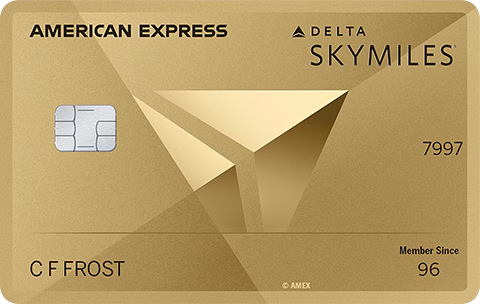
Credit cards are hands-down the easiest way to avoid bag fees if you’re not flying an airline that covers bags. Many airline co-branded cards offer at least one free checked bag for the cardholder, and often extend it to multiple companions. That means the annual fee can pay for itself after just one or two trips.
Cards That Cover Bag Fees
Card | Free Bag Benefit | Companion Coverage |
1 free bag | Up to one companion | |
1 free bag | Up to eight companions | |
1 free bag | Up to eight companions | |
1 free bag | Cardholder and up to three companions | |
AtmosTM Rewards Ascent Visa Signature® Card | 1 free bag | Up to six companions |
And don’t forget Southwest cards. While the airline used to allow two free checked bags for all travelers, its co-branded cards now offer one free checked bag for you and up to eight companions.
👀 Pro Tip: Some airlines require you to purchase your ticket with the eligible card to trigger the benefit. Others just need the cardholder’s name on the reservation. Always double-check the rules before assuming your bag is free.
Use Travel Credits
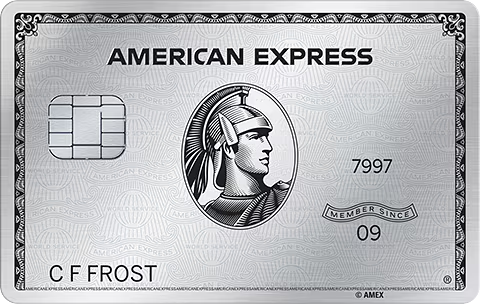
Not flying your “home” airline? That’s where premium cards come in clutch. American Express Platinum Card® (enrollment required) and Chase Sapphire Reserve® both offer airline incidental credits that can reimburse bag fees, seat selection, or in-flight snacks.
The nice part here is flexibility, because if you’re flying United one month and Delta the next, you can still get those fees reimbursed. Just remember to pick your airline in advance (Amex requires this) or pay directly to the airline to activate the credit.
Use Elite Status and Loyalty
In many situations, it pays to be loyal! Frequent flyers can skip bag fees altogether by earning elite status. Even entry-level tiers like United Premier Silver or Delta Silver Medallion include at least one free checked bag. And if you’re traveling with companions, your status usually covers them, too.
Even without status, some airlines include a checked bag on long-haul international flights by default. So while domestic economy tickets usually come with baggage fees, flying to Europe or Asia in economy may still include a free bag.
Pack Smarter
It might sound obvious, but traveling with just a carry-on can be the single best way to beat baggage fees. Airlines can’t charge you for what you don’t check. That said, low-cost carriers are starting to get stingy with carry-ons, too, so always check the fare rules.
If you’re determined to go ultra-light, a “personal item” bag that fits under the seat can sometimes replace a carry-on altogether. There are entire Reddit threads devoted to under-seat bags that carry a week’s worth of clothing, so it’s worth a look if you want to avoid fees. Me personally? I’m a backpack traveler through and through! ☺️
Remember that airlines charge per bag, not per passenger. If you’re traveling with a group, consolidate into fewer checked bags instead of everyone bringing their own. Splitting a large suitcase can easily save $50 (or more) each way.
And for families, baby gear like strollers and car seats are almost always checked for free, so use that to your advantage when packing.
Know the Exceptions
There are definitely some built-in exceptions most people don’t think about:
Special equipment: Wheelchairs, medical devices, strollers, and car seats can usually be checked for free.
International routes: Many transatlantic and transpacific flights include at least one free bag in economy.
Bundled fares: Some airlines now offer “bundle” fares that include extras like seat selection and bags, and sometimes these cost less than buying a basic fare and bag separately.
Airline Bag Fee Comparison
Here’s what you’re looking at for standard first and second checked bag fees on major U.S. airlines, so you can see potential savings with the right perks.
Airline | First Checked Bag Fee* | Second Checked Bag Fee* | Typical Perks / Ways to Avoid |
About $35 | About $45 | Rapid Rewards credit card holders, A-List/A-List Preferred, fare class exemptions | |
$35 to $40 | $45 to $50 | United co-branded cards, status, bundled fares | |
$30 to $40 | $45 to $60 | Delta partner cards, Medallion status, premium cabin and bundle fares | |
$30 to $40 | $45 to $60 | AAdvantage cards, status, and higher fare tiers | |
$35 to $40 | $45 to $55 | JetBlue Plus, Mosaic status, bundle options |
*Fees for standard economy, non-elite passengers may vary by route, weight, and special items, so always double-check before flying!
Bottom Line
Airlines love their baggage fees, and they rake in tons of money from them every year. But that doesn’t mean you have to pay. Between certain airline policies, co-branded cards that take care of fees, and premium cards that reimburse you for incidentals, there are plenty of ways to plan ahead.
For the average traveler, the smartest play is to pick one airline card that matches where you fly most often. That way, you’ll consistently save on bag fees, and the benefit alone can justify the card’s annual fee. Combine that with some smart packing, and you can avoid paying those annoying extra fees (and maybe spend that cash on some fun airport snacks, instead!).