

🏃♂️TRENDING TRAVEL NEWS 🏃♂️
• Adventure Seekers: Enter to run every major marathon with Abbott World Marathon Majors (travel included).
• Trip Inspo: This Porto street just made the “coolest in the world” list, and here’s why.
• Global News: Caribbean flights are rebounding after recent disruptions, so check updates here.
• Private-ish Flying: JSX just added new nonstop flights between these two cities.

🌅 Good morning, folks. Welcome back to Daily Drop, your one and only travel companion (if you have another travel companion, I’ll be extremely jealous).
Knowing what I know about you all, I suspect you’ll enjoy today’s newsletter:

✈️ How I booked Delta One on the cheap
If you’re like most American travelers, you probably love Delta. And I’ll say, I’ve generally had good experiences with Delta.
My only issue is their loyalty program. It’s pretty trash, and Delta SkyMiles are even more trash.
They’re hard to rack up quickly, and flight prices are so inflated that you have to drain your entire balance for a single flight sometimes.
So today, I’m going to tell you about the BETTER way to book Delta flights – even long-haul, international flights in Delta One.
Case Study: My long-haul flight in Delta One
Next month, I’ll be in New York. 🗽
I had a nice Air France business-class flight booked to Europe, but after getting robbed on Christmas in the Netherlands, I decided – no more Europe for me.
Instead, I decided to head to West Africa, where I’ll be hitting six cool countries, starting with Senegal. 🇸🇳
You may not know this, but Delta actually flies nonstop from New York (JFK) to Dakar (DSS), Senegal.
As you can see, however, flight prices are crazy…

New York to Dakar with Delta SkyMiles
This is where it makes more sense to book Delta flights with partner programs.
Instead of paying 255,000 SkyMiles for business class across the pond, I found the same flight on the exact day I needed it for just 70,000 Flying Blue miles.👇

New York to Dakar (on Delta) for 70,000 Flying Blue miles
As you can see, even economy class is half of what Delta charges and significantly less in business class.
💡 Pro Tip: When you use Flying Blue miles, you’re typically booking into a “standard” cabin class, which comes with seat selection and other perks. Delta’s lowest prices are often more restrictive – so keep this in mind when you’re deciding which program to use.
Even though this is on a Boeing 767, it’s still marketed as “Delta One” and will be a fantastic way to cross the ocean in comfort.
The taxes and fees are $45, which is only $27 more than what Delta charges – well worth it for the mileage savings.
This trick works most of the time, but not always
Generally speaking, I HIGHLY recommend using Flying Blue to book Delta flights.
Even on very short domestic flights, Flying Blue will charge as few as 5,000 miles to fly on Delta, with pretty good availability.

Domestic Delta flights booked with Flying Blue miles
At the same time, you want to keep your options open. Sometimes, Delta has solid deals using SkyMiles.
For example, the flights I just showed a second ago can cost as few as 5,100 Delta SkyMiles – basically the same as what Flying Blue charges, but with lower taxes and fees.

In this case, it makes more sense to use Delta SkyMiles.
Keep your options open
So here’s what I recommend:
If you like flying Delta, rack up a crap load of Membership Rewards points, which transfer to both Delta and Flying Blue.
When it comes time to book a flight, you can search both programs and transfer points where it’s most optimal (or use them for something other than Delta).

💳 My favorite underrated airline card
Speaking of Delta…
The other day, I told you about what I think is the most underrated hotel card out there.
Today, I want to tell you about a pretty underrated airline card – and yes, it’s a Delta card.
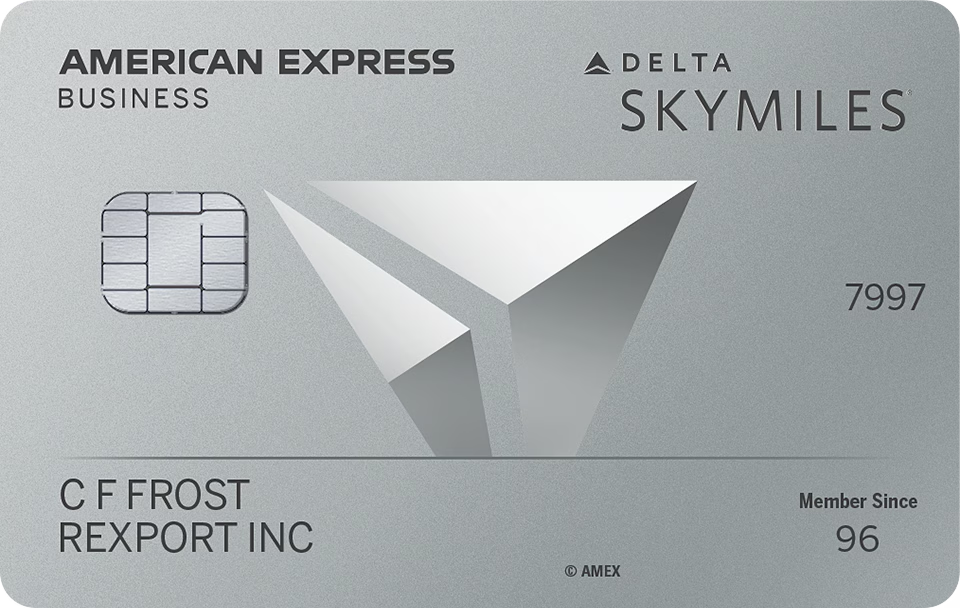
Specifically, I’m talking about the Delta SkyMiles® Platinum Business American Express Card.
☝️ By the way: Don’t automatically write this off because it’s a business card. If you don’t understand the rules about who can apply for business cards, check out this article… because you probably can. 😉
The credits are simple and useful
For starters, the credits that come with the Delta Platinum Business Card are generally quite easy to use:
$120 per year on rideshare apps (up to $10/mo)
$120 per year on dining at Resy restaurants (up to $10/mo)
Up to $200 per year on hotels booked through Delta Stays
Let’s talk about that last credit…
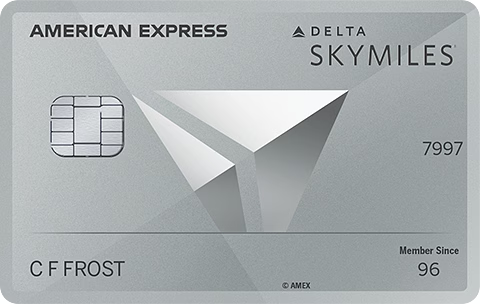
The personal version (the Delta SkyMiles® Platinum American Express Card) has the same annual fee, but the Delta Stays credit is only $150… which is why the business version is better.
But here’s the fun thing about these Delta Stays credits…
You can use it to book a fully refundable hotel. And if you end up needing to cancel that hotel stay, the credit stays on your account…

I have the higher-tier card, which is why my credit was $250
Is this supposed to happen? I don’t know. But what I can tell you is that this has worked for me every year… so that credit can basically become cash.
Anyway, those credits add up to $440 per year. So even if you can’t use all of them, it’s very easy to justify the card’s annual fee…
The Delta-specific perks
Now that the annual fee is covered, you essentially get the rest of the Delta-specific perks for free every year:
15% discount on Delta award flights with the TakeOff15 benefit
2,500 MQDs every year just for holding the card
Annual companion certificate to use on Delta flights in North America (terms apply)
Oh – and of course, there’s a welcome offer (which is also higher than the personal version of the card) to build up a nice stash of miles on top of everything else. 🤷🏼♂️
Anyway, this is one of those cards that just kind of works – especially for Delta fans… but even for non-Delta fans who just want an easy-to-justify airline card.

PRESENTED BY PERCENT
📈 A different way to think about “diversification”
If your entire portfolio lives in stocks and bonds, here’s a mildly uncomfortable stat: most companies aren’t even public.
This means a huge chunk of the economy (and opportunity) never shows up on a ticker.
That’s where Percent comes in.

Percent is a platform that gives accredited investors access to private credit deals –shorter-term, asset-backed investments designed to generate income, not just vibes.
Instead of waiting years and hoping the market cooperates, these deals typically run for months (the average is around nine) and are structured to pay interest along the way.
A few highlights:
Deals with short-term durations (some as short as six months)
Asset-based structures, not speculative equity bets
A relatively low $500 minimum to get started
In 2024, Percent investors saw 14.9% average net returns
Percent has facilitated over $2B in transactions since 2018, with full transparency into each deal – borrower info, structure, and risk factors included.
If you’re looking to diversify beyond the public markets (without locking your money up for a decade), this is worth a look.
Alternative investments are speculative and possess a high level of risk. No assurance can be given that investors will receive a return of their capital. Those investors who cannot afford to lose their entire investment should not invest. Investments in private placements are highly illiquid and those investors who cannot hold an investment for an indefinite term should not invest. Private credit investments may be complex investments and they are subject to default risk.

That’s all for today, folks!
Hope you enjoyed this very Delta-centric newsletter. Stay tuned for the rest of the week, where we’ll talk about more than just Delta (I promise).
Ciao,
With contributions by McKay Moffitt