Listen y’all… it’s no secret that safaris are expensive (to say the very least).
Planning a safari with miles and points isn’t about getting a “free” trip.
But a safari is one of the best examples of how miles and points can help plan trips that would otherwise feel completely out of reach. Flights, lodges, and even luxury camps can all be offset (sometimes dramatically) with the right strategy.
Safaris are still complex, still premium, and still very much a splurge. But again, points can turn a five-figure situation into something far more realistic.
The Core Pieces of a Safari Trip
Safaris involve a ton of decisions. And the biggest mistake people make is assuming points will cover everything. They won’t. But they can cover the most expensive parts.
Booking Flights For a Safari
Flights to Africa are long, competitive, and often super expensive in cash, which makes them ideal for points. This is where transferable points do the most heavy lifting, especially in business class.
You’ll usually route through Europe or the Middle East, which opens up far more options than trying to fly nonstop.
Airlines such as Ethiopian and Kenya Airways have nonstop routes between the U.S. and sub-Saharan Africa, plus excellent award availability through programs like Aeroplan, Flying Blue, or United MileagePlus.
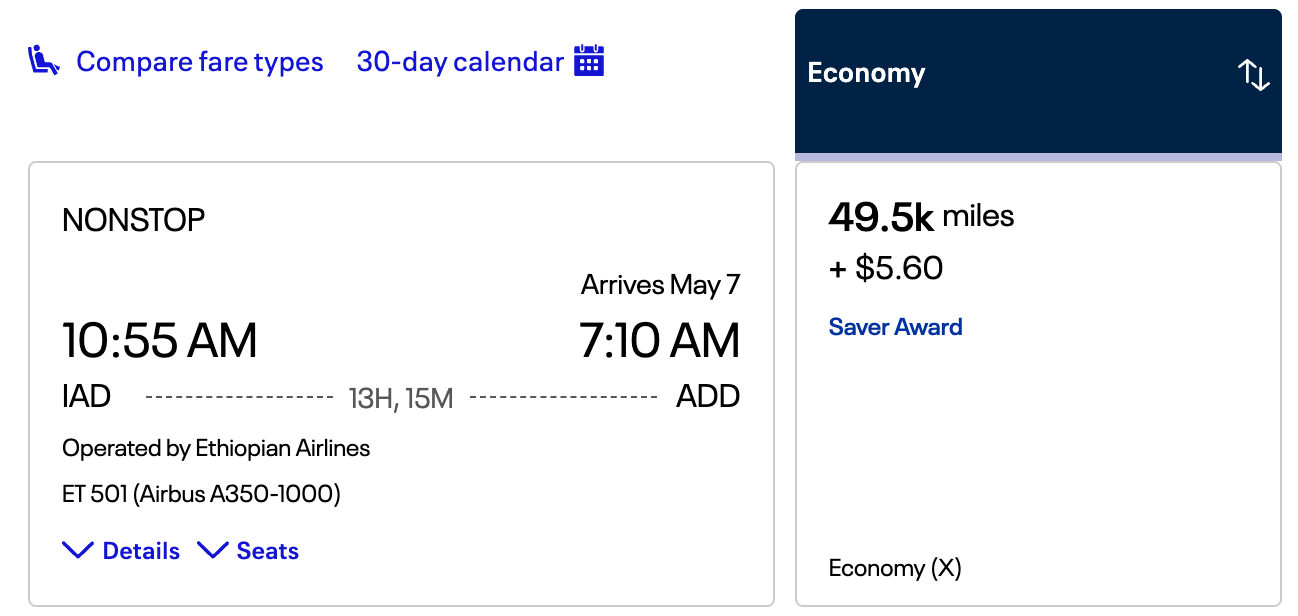
Washington D.C. to Addis Ababa on Ethiopian Airlines using United Miles
Kenya Airways flies non-stop to New York and can be booked with Delta, Flying Blue, and other SkyTeam programs like Virgin Atlantic, usually for around 50,000 miles in economy.

New York to Nairobi on Kenya Airways using Virgin miles
Virgin has frequent transfer bonuses from U.S. credit cards, so it could end up being a lot cheaper if you time it right.
🧠 Pro Tip: Don’t lock in flights until your lodges are confirmed. Safari camps are capacity-constrained, so flights are flexible by comparison.
Booking Safari Lodges
This is where safaris get expensive fast, and where recent changes have made points far more relevant.
Most lodges:
Require 2 to 3-night minimum stays
Are all-inclusive (meals, drinks, game drives)
Price per person, not per room
So yes, a $1,500 “night” is often $3,000 for two people. Using points here doesn’t just save money, but it could also make your trip feasible.
Transfers, Bush Flights, and Logistics
This is the least glamorous part… and usually not points-friendly. 🙃
Small-plane flights between camps, park fees, and transfers are often paid in cash and arranged after you book the lodge. These costs add up, but they’re also unavoidable, so it’s best to mentally separate them from the points strategy.
🌟 Another Pro Tip: Some lodges bundle transfers into the nightly rate, so always check before assuming it’s extra.
Best Airline Programs for Getting to Africa
When people search “best ways to fly to Africa with points,” they’re usually trying to avoid two things: insane mileage prices and crazy routing.
Here are some programs that’ll give you decent options.
Air France-KLM Flying Blue
Flying Blue is one of the most reliable programs for Africa, especially East Africa.
For example, New York to Paris to Nairobi in premium economy starts around 65,000 miles one-way, depending on availability, often far less during Promo Rewards.
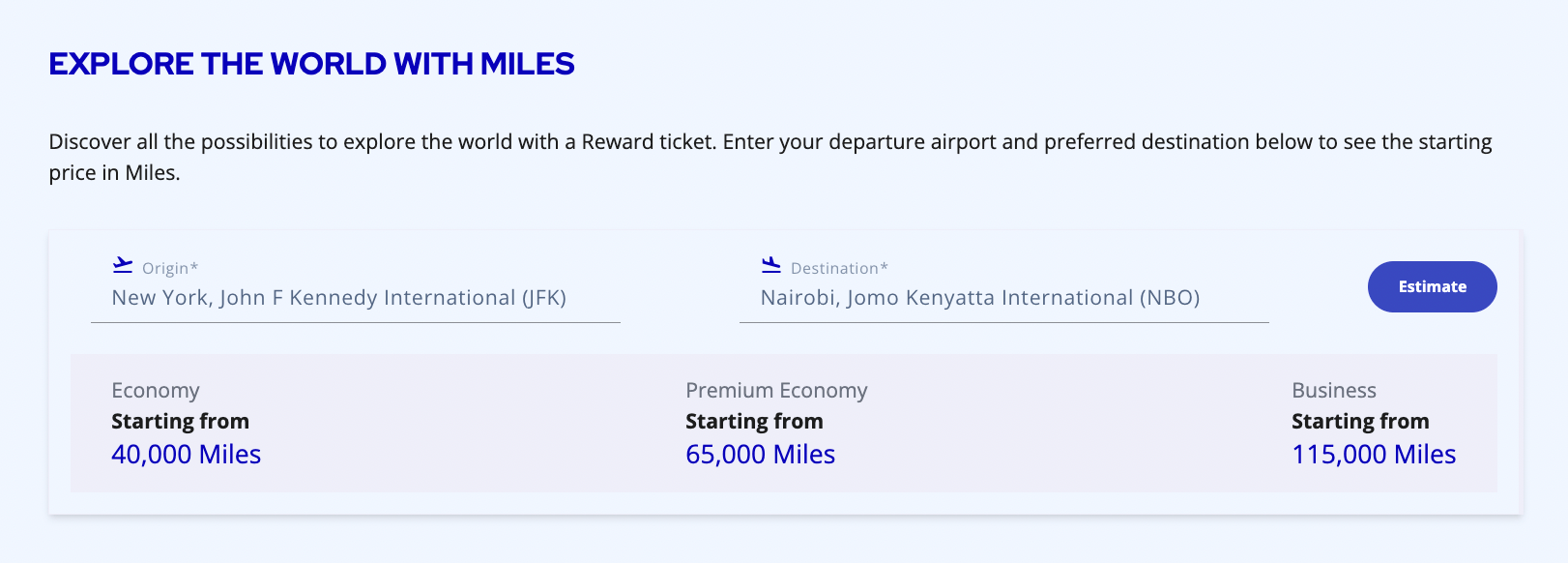
Example award pricing from New York (JFK) to Nairobi (NBO) on Flying Blue
Transfers from American Express, Chase, Capital One, and Bilt make this easy to top off. And, Flying Blue’s calendar view is your friend… so is flexibility.
Air Canada Aeroplan
Aeroplan is great for Star Alliance routes via Europe or the Middle East.
Think United or Lufthansa to Europe, then onward to Africa, often with reasonable pricing and no crazy fuel surcharges.
For example, here’s a direct route from Washington, D.C. (IAD) over to Addis Ababa (ADD) with a connection in Cairo for just 55k points in economy. Not to mention, this is during October… aka dry season in Ethiopia… aka one of the best times to book a safari there… just saying.

D.C. (IAD) to Addis Ababa (ADD) for 55k points on Egyptair via Aeroplan
Aeroplan is also great for mixed itineraries, which matters when safari routes get funky.
Let’s look at another option using Aeroplan, but on Ethiopian Airways.
British Airways Avios
Avios can work well, but only if you’re intentional.
Cash fares on British Airways might be painful, but Avios pricing can still make sense if you’re transferring during a bonus and avoiding peak dates.
👀 Heads Up: Avios tend to do better for niche routes than blanket “best value” claims.
Best Credit Card for Safari Trips
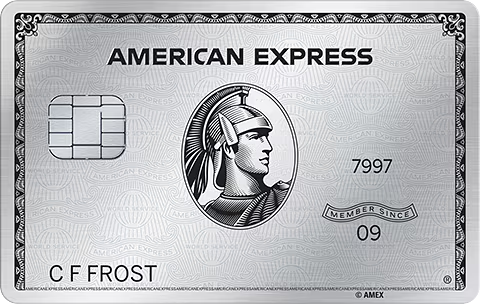
Safari trips are all about flexibility moreso than loyalty. Cards that earn transferable points (like the Chase Sapphire Preferred® Card, for example) give you access to multiple airline programs, hotel collections, and great travel protections. That combination matters far more here than squeezing out an extra point per dollar.
Beyond lounge access, this card is great on safari trips for:
Trip delay and cancellation insurance
Global Assist Hotline for remote destinations
Amex Fine Hotels + Resorts® for pre- or post-safari city stays
This card pairs really well with safari travel:
$300 annual travel credit (great for positioning flights)
Capital One Premier Collection for city hotels before/after
Simple 2x earning everywhere, which is just solid for… everything
If you use the $300 credit on flights and redeem 75,000 miles for a $750 positioning flight or hotel, that’s $1,050 of value already, which could be a huge chunk of your trip.
Booking Safari Lodges With Points
This is where safari planning gets… complicated. Safari lodges are small, remote, often independent, and very expensive.
That’s why recent hotel-program expansions could be worth a look.
Marriott Bonvoy
If there’s one hotel program that consistently shows up in safari destinations, it’s Marriott Bonvoy.
Marriott has luxury properties near the Masai Mara (Kenya), the Serengeti (Tanzania), and the Kruger region (South Africa).
Why Marriott works well:
Points + Cash bookings
Fifth-night-free on award stays
Easy transfers from Chase and American Express
This is often the best option for people who want luxury-adjacent safari experiences with some brand familiarity.
Hyatt’s New Safari Lodges
Hyatt quietly changed the safari game.
Through its Mr & Mrs Smith partnership, World of Hyatt now allows members to book select safari lodges in Kenya, Tanzania, and Uganda with points.
👉 Mike dives into the new-ish Hyatt safari properties more in this newsletter.
Why this rocks:
Safari lodges were previously cash-only
Many nights run $1,200 to $2,000+ per night
Points unlock access, not just “value”
Is the math amazing? Not always. But this is about access, not squeezing out 5 cents per point. Most of these lodges are all-inclusive, include meals, drinks, and game drives, and have multi-night minimum stays.
Pro Tip: You can transfer both Chase Ultimate Rewards and Bilt Rewards to Hyatt, making this a real option for people sitting on points.
What About Luxury Hotel Collections?
Safari trips often involve at least one city stop before or after the bush, and this is where luxury collections come to play.
Use Amex Fine Hotels + Resorts®, Chase’s “The Edit,” or the Capital One Premier Collection for:
Pre-safari nights in Nairobi, Cape Town, or Zanzibar
Post-safari decompression (or just trip-timing)
Extra perks like breakfast, upgrades, and late checkout
These bookings won’t be free, but they can stack benefits in ways safari lodges usually don’t.
Safari Planning Timeline
12+ months out: Start researching safari regions and lodges. Availability is limited, and popular camps book far in advance.
9 to 12 months out: Lock in safari lodges first, especially if booking with hotel points. Minimum stays and limited inventory matter more than flight pricing.
6 to 9 months out: Book international flights using airline miles. This is when you’ll usually find the best balance of availability and pricing.
3 to 6 months out: Arrange transfers, bush flights, and any add-on destinations (like Zanzibar or Cape Town). Expect some cash costs here.
30 to 60 days out: Finalize logistics, seat assignments, and hotel stays before or after the safari using Amex FHR, Chase The Edit, or Capital One Premier Collection.
🙂 And Don’t Forget: If something feels backwards, remember this rule: lodge first, flights second, details last.
Bottom Line
A safari will probably never be “cheap.” But that’s not the point.
Miles and points turn a trip that feels financially impossible into one that’s simply… complicated. And complicated is manageable. Flights are bookable. Lodges are finally accessible. Hotel programs are catching up to the experience.
If a safari has been sitting on your bucket list for years, this is one of the clearest paths to making it real by having a flexible attitude and some miles and points in your pocket.