

At the end of the year, credit card perks are honestly slept on. To be fair, there is a lot going on. Like… a lot.
So before you lock into your holiday shopping list and end-of-the-year festivities, let’s chat about how you can squeeze every last drop out of your wallet.
If you time things right, you can swipe hundreds (or even over $1,000) in statement credits from cards, open or upgrade a card, use what’s left of this year’s perks, and then do it all again when those benefits reset in January — all before you’ve even paid a second annual fee.
For cards with calendar-year or semiannual credits, opening late in the year lets you use what’s left now and then tap a fresh set when benefits reset.
This, my friends, is called “double-dipping.”
What does “double-dipping” actually mean?
“Double dipping” is when you use a card’s credits in two separate benefit periods while only paying one annual fee.
Most premium cards structure their credits in one of three ways:
Calendar-year credits (reset every Jan. 1)
Semiannual credits (Jan. to June and July to Dec. windows)
Monthly or quarterly credits (spread through the year)
If you open or upgrade a card in, say, November, you can often use what’s left of this year’s credits in November/December, then use a fresh set in January/February…
… all before your next annual fee hits.
You’ve now secured two rounds of value inside one membership year (yay, you!). Just keep in mind that some credits reset on your cardmember anniversary instead of January 1st.
❤️ Pro Tip: Double dipping is all about benefit timing. You still need to use your card for real spending and follow the terms. Card issuers know that end-of-year approvals drive signups. You’re just choosing to play along strategically.
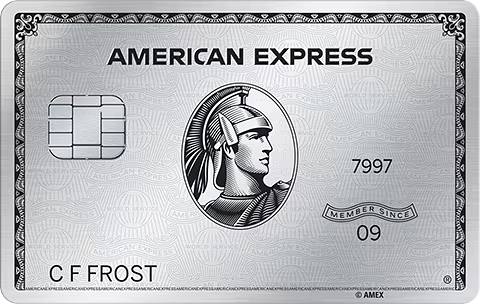
If you’ve ever wanted to test drive a premium card such as the Capital One Venture X Rewards Credit Card, Hilton Honors American Express Aspire Card ($550 Annual Fee;see rates & fees), Chase Sapphire Reserve®, or even the American Express Platinum Card® ($895 Annual Fee; see rates & fees), this is quite literally the best time of the year to open or upgrade one.
Calendar Year vs. Cardmember Anniversary
This is obviously just the bones, but here’s the quick distinction:
Reset Type | Typical Cards | Ideal Timing | Best for Double Dip? |
Calendar Year | Most Platinum Card® credits, many Hilton perks (like FNAs, status, and so on) | Jan 1 | ⭐️ Yes — high potential |
Semiannual Window | Hilton Amex Aspire resort credits and hotel credits | Two semiannual windows each year | ⭐️ Yes — if opened before a new semiannual period starts |
Monthly/Quarterly | Lyft/DoorDash on Chase Sapphire Reserve®, Uber on Platinum Card®* | Monthly | 👍 Depends on timing |
Cardmember Anniversary | Sapphire Reserve $300 Travel Credit** | Anniversary month | ❌ No calendar-based dip |
So, if your goal is maximum value during year one, open near the end of a calendar or semiannual period. So like… right now. 🙂
*To receive this benefit, you must have downloaded the latest version of the Uber app, and an eligible American Express Card must be linked as a payment method on your Uber account. The Amex Benefit can only be used in the United States.
**Note that you don’t earn points on travel purchases until this credit is exhausted.
Best Cards for Year-End Timing
Let’s walk through the top contenders and where the year-end strategy truly shines.
$200 airline fee credit (which resets Jan. 1)
Up to $600 in Fine Hotels + Resorts or Hotel Collection credits, split into two $300 semiannual amounts each year when you book prepaid stays through Amex Travel
Monthly $10 Uber Cash (including a $15 December boost)
Other lifestyle credits (Clear+, digital entertainment, etc.), typically monthly or annual
Apply in November or December, and you could secure a portion of this year’s airline credit and monthly perks, then another full round starting in January
Bottom Line: You’re looking at $500 to $1,000+ in credits before your second annual fee if you start at the end of the calendar year.
$400 in Hilton resort credits each year, split into two $200 semiannual credits at participating Hilton resorts
Up to $50 flight credit per quarter
Annual free night certificate valid for standard rooms at many Hilton properties, including lots of higher-end options when standard rooms are available
Apply in November, then use Jul–Dec resort credit and Q4 airline credit
Then immediately access Jan–Jun resort and Q1 airline credit
Bottom Line:
That’s $400 in resort credit and $100 in airline credit before summer, plus elite Diamond status.
Not the classic double-dip candidate due to anniversary-based travel credit, but still meaningful if you open at the end of the year.
$300 travel credit (resets based on anniversary, also remember that you don’t earn points on travel purchases until you exhaust this credit)
Up to $150 biannual credits at Sapphire Reserve Exclusive Tables
Multiple monthly perk credits, including Lyft, and DoorDash
New partner-specific credits (Apple, StubHub, etc.)
$250 semi-annual credit for The Edit hotels
This means you could open the card this month, use the credit for a stay next year, then in January use BOTH new credits for the same hotel, effectively putting $750 toward a single “stay” in 2026.
Bottom Line: While you can't double dip the travel credit, a December approval still allows you to grab December and January monthly perks and a fat hotel credit before reassessing next year.
Not tied to calendar-year resets, but still worthy of mention due to the current limited-time 75,000-mile offer.
$300 towards Capital One Travel per cardmember year
10,000 anniversary miles each year
Unlike some cards, these travel credits and bonus miles are tied to your account’s annual cycle rather than the standard calendar year
Bottom Line: While this one is not a double-dip card by design, pairing the year-end welcome offer with future credit use makes this timing pretty ideal if you're stacking multiple card strategies.
Other Cards to Consider
Card | Why It Works |
Calendar-year travel and hotel credits and enhanced status benefits | |
Calendar-year airline credit and statement perks, highly stackable with travel spend | |
Premium hotel cards (Marriott Bonvoy Brilliant® American Express® Card, etc.) | Some offer calendar-based property or dining credits |
Stacking Bilt and Platinum Card®
Here’s where things get spicy.
You can link almost any credit card to your Bilt account and earn an extra one Bilt point per dollar on eligible transactions through the Bilt Travel Portal, whether you’re using the Sapphire Reserve, Venture X, or even a corporate card.
But Platinum Card® users get a little something special here — 5x points on flights booked directly through the airline — one of the richest earning rates you’ll find on flights.
This means: the Platinum Card® + Bilt Portal (when paid in full on your Platinum Card®) = 5x Membership Rewards points + 1 Bilt point per dollar.
That’s essentially a 6x earning rate, which is absurd for paid airfare.
But, there’s a caveat big enough to lose those points entirely: If you use Bilt points even partially (at 1.25 cpp) to lower the cost of your flight, Bilt becomes the merchant of record. They process the remainder internally, so it’s not classified as an “airline purchase.” Hence, you’d only earn 1x.
👀 Heads Up: If you want the full double-dip benefit, pay entirely with your linked card. Do not apply Bilt points at checkout. Use them later for more strategic redemptions, ideally toward flights where you can’t otherwise extract higher cash-back or transfer value.
This is based on how things are currently coding and could change, so treat it as a high-value quirk, not a guaranteed long-term feature.
Gentle Reminder About Annual Fee Refunds
Premium annual fees are steep. The good news is… you usually have a grace period.
If you decide after nearly a year that the card doesn’t deserve a place long-term, many issuers have a short grace period after an annual fee posts, where you may be able to cancel or downgrade and get some or all of the fee back. Policies vary quite a bit, so it’s worth calling your bank before you rely on that
For example, if your Platinum Card® annual fee posts on July 1, you typically have until July 31 to make a decision. Refunds are credited as if the fee never posted.
But that’s where things get a little weird…
Let’s say you open a card this month. You’ll get annual credits for 2025, then, next year, get them all for 2026…
But then, your annual fee will hit again in December…
… so you could theoretically get that fee refunded sometime in January (within 30 days of it hitting).
And in January, before getting the annual fee refunded, you could technically use 2027 credits too.
That’s called triple dipping. And it’s insane that it’s possible.
🧠 Another Pro Tip: Don’t open a card intending to bail as soon as you’ve double dipped, but the buffer does exist in case you realize the card doesn't fit long-term.
How to Actually Move Forward
Ok, phew. Deep breath. Let’s talk through this decision-making flow:
Start with your year ahead. Will you realistically book flights, use resort or hotel credits, pay for dining or rideshares, or stay at properties that match the card’s benefits?
Choose a card with perks you naturally align with. The strategy only works if you’ll use the credits without forcing any extra spend.
Time your application before credits reset. Mid-November through mid-December is typically ideal.
Use the expiring credits immediately. Book travel, charge hotel stays, or trigger monthly credits before December ends.
Track your upcoming January reset. Plan early for the next year so those perks don’t get overlooked.
If you’re throwing Bilt into the mix: connect your preferred earning card, pay in full if you’re maximizing those multipliers, and avoid partially paying with points on airfare.
Evaluate near your renewal date. If the card continues to match your spending and travel patterns, keep it. If not, you’re still in a position to exit without any major losses.
Who Should Not Try This
If you’re someone who plans to overspend to “justify” credits, skip it. If you’re under financial pressure from multiple new accounts, skip it. If you know you won’t use credits naturally through normal travel patterns, skip it.
And if you struggle with benefit tracking… you guessed it… I would skip it. This strategy requires some decent attention to detail.
Bottom Line
Opening a premium card at the end of the year gives you a chance to experience its full suite of benefits under primo conditions. It’s a smart move that lets you test out a high-end product during a “major upside” period before committing to it long-term.
If you’ve been considering the Platinum Card®, Hilton Amex Aspire, or a well-rounded pairing with the Bilt Card and a premium travel card, now is when the numbers are looking the sweetest. The end of the year is when the clock resets and the “miles-and-points elite” quietly get ahead. That’s you, by the way. 😙